
Originally posted on Friday, January 3rd, 2014
Notwithstanding Paul Krugman’s obsessive derogation of the gold standard — and a recent bungled attempt by Prof. Krugman to enlist Adam Smith as an authority for his position —
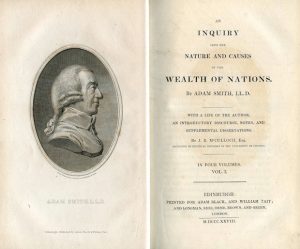
James Tassie‘s enamel paste medallion of Smith courtesy of Wikipedia

— it is clear that Smith understood precisely how elegant the mechanism by which the classical gold standard worked to allow the marketplace itself to regulate liquidity balances.
Smith, in Wealth of Nations, Chapter II Part II:
Let us suppose that all the paper of a particular bank, which the circulation of the country can easily absorb and employ, amounts exactly to forty thousand pounds; and that for answering occasional demands, this bank is obliged to keep at all times in its coffers ten thousand pounds in gold and silver. Should this bank attempt to circulate forty-four thousand pounds, the four thousand pounds which are over and above what the circulation can easily absorb and employ, will return upon it almost as fast as they are issued. For answering occasional demands, therefore, this bank ought to keep at all times in its coffers, not eleven thousand pounds only, but fourteen thousand pounds. It will thus gain nothing by the interest of the four thousand pounds excessive circulation; and it will lose the whole expence of continually collecting four thousand pounds in gold and silver, which will be continually going out of its coffers as fast as they are brought into them.
Neither Smith nor the modern proponents of the classical gold standard consider it to be flawless. It merely is, as Lewis E. Lehrman, founder and chairman of the Lehrman Institute, consistently observes: the least imperfect monetary system ever attempted as demonstrated in the laboratory of history. Smith:
Had every particular banking company always understood and attended to its own particular interest, the circulation never could have been overstocked with paper money. But every particular banking company has not always understood or attended to its own particular interest, and the circulation has frequently been overstocked with paper money.
By issuing too great a quantity of paper, of which the excess was continually returning, in order to be exchanged for gold and silver, the Bank of England was for many years together obliged to coin gold to the extent of between eight hundred thousand pounds and a million a year; or at an average, about eight hundred and fifty thousand pounds.*17 For this great coinage the bank (in consequence of the worn and degraded state into which the gold coin had fallen a few years ago) was frequently obliged to purchase gold bullion at the high price of four pounds an ounce, which it soon after issued in coin at 3l. 17s. 10½d.an ounce, losing in this manner between two and a half and three per cent. upon the coinage of so very large a sum. Though the bank therefore paid no seignorage, though the government was properly at the expence of the coinage, this liberality of government did not prevent altogether the expence of the bank.
Gold is imperfect. So is expert managed currency.
Over 40 years of the “Federal Reserve Note Standard,” freed of gold’s definitional requirements, correlates, according to the Bank of England, to more frequent, deeper and longer recessions, worse inflation, worse job creation, and more banking and currency crises. Rather than arguing from doctrine (and even dogma), or even by reference to authority, as Prof. Krugman does by digging up some old tropes of Keynes, or by knocking down straw man arguments … it is long past time that the proponents of fiduciary monetary policy to start arguing from empirical data. Unfortunately for the proponents of money managed by elite civil servants the data do not support their infatuation.
Recent Comments