
Originally posted on Thursday, November 28th, 2013
A charming story on the discovery of tiny amounts of gold in the leaves of the Eucalyptus tree recently received worldwide attention.
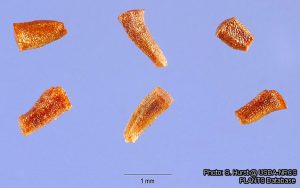
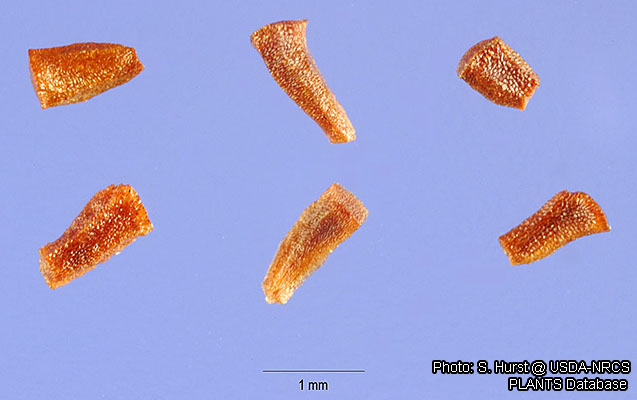
Seeds of the Eucalyptus Tree, photo by S. Hurst courtesy of Wikipedia
As summarized in the National Geographic‘s Daily News:
There’s gold in them thar trees. Eucalyptus trees, that is. Australian researchers have found that microscopic gold particles from underground ore deposits are present in tree leaves.
Eucalyptus tree roots can delve more than 130 feet (40 meters) deep underground in a thirsty search for water. (See “Koalas Climb a Eucalyptus Tree.”)
The Nature Communications journal results, reported by a team led by Melvyn Lintern of Australia’s CSIRO Earth Science and Resource Evaluation science agency, settle a long-running dispute. Researchers had disagreed over whether gold particles seen in eucalyptus leaves were merely wind-blown or truly represented ore traces transported by roots.
With gold costing more than $1,300 an ounce, miners might want to look hard at these eucalyptus tree findings, the team suggests. Gold discoveries have declined roughly 45 percent over the last decade. (Related: “Will Deep-sea Mining Yield an Underwater Gold Rush?”)
Don’t start stuffing eucalyptus leaves in your wallet, however. The average concentration of gold in the leaves was only about 46 parts per billion, less than 0.000005 percent of each leaf by weight.
The Koala need not, it appears, fear humans competing unduly for its staple food.
A report on this find by AFP states:
According to the World Gold Council, more than 174,000 tons of gold have been extracted from Earth since the dawn of civilization.
In 2011, the US Geological Survey estimated there were 51,000 tonnes of gold left in reserve in the world.
The reference to the 2011 USGS estimate appears to reference known reserves. That report estimates 51,000 tons of known gold reserves based on various governmental estimates. 3,000 of these reportedly are in the United States. A footnote to the report states: “An assessment of U.S. gold resources indicated 33,000 tons of gold in identified (15,000 tons) and undiscovered (18,000 tons) resources” — an order of magnitude higher than “reserves.”
If the same ratio applies worldwide it would imply that 510,000 tonnes of gold not yet extracted from the Earth. That is about three times the amount of refined gold extant in the world, as reported by the BBC: 171,300 tonnes.
For monetary purposes, the quantity of available gold, refined and awaiting extraction or even discovery, can only be characterized as ample. As previously noted here, Erste Bank states that “gold is money not because it is scarce but because it is abundant.”
Those who claim that there “isn’t enough gold” to support a gold standard, however, are collapsing a critical distinction. Under the classical gold standard gold acts as the calibrator by which currency is either injected into or withdrawn from the marketplace based on market demand.
Thus gold, under the classical gold standard, is akin to the thermostat rather than the furnace. It adjusts the liquidity to the precise balances desired by the marketplace — rather than relying on convoluted equations by central planners.
Wild estimates of a $50,000/oz gold price under a gold standard are simply, and completely, unfounded. Such estimates — and claims that there is not enough gold to support a gold standard — betray a lack of understanding of the simple, elegant, and effective mechanism by which the classical gold standard organically regulates the supply of money.
Gold has proven an ideal instrumentality by which to define the dollar. This may be due, in part, to the demonstrated stability of its “stock to flow ratio” — an argument elegantly outlined by the Gold Standard Institute’s estimable president Philip Barton. Because little gold is consumed industrially, this, too, makes gold optimal as the operational factor in conducting monetary policy.
Recent Comments