
Originally posted on Thursday, November 21st, 2013
This blogger thought his $100 trillion Zimbabwe bank note was extreme.
Turns out, not.
Try 100 quintillion on for size.
Pengos.
It was worth — in 1946 — about 20 (American) cents.
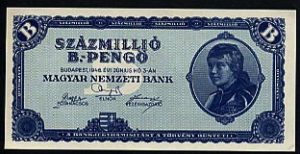
Courtesy of Tom Chao’s Paper Money Gallery
From The Smithsonian’s Past Imperfect:
The great German hyperinflation of 1923 is passing out of living memory now, but it has not been entirely forgotten. Indeed, you don’t have to go too far to hear it cited as a terrible example of what can happen when a government lets the economy spin out of control. At its peak in the autumn of that year, inflation in the Weimar Republic hit 325,000,000 percent, while the exchange rate plummeted from 9 marks to 4.2 billion marks to the dollar; when thieves robbed one worker who had used a wheelbarrow to cart off the billions of marks that were his week’s wages, they stole the wheelbarrow but left the useless wads of cash piled on the curb. A famous photo taken in this period shows a German housewife firing her boiler with an imposing pile of worthless notes.
Easy though it is to think of 1923 as a uniquely terrible episode, though, the truth is that it was not. It was not even the worst of the 20th century; during its Hungarian equivalent, in 1945-46, prices doubled every 15 hours, and at the peak of this crisis, the Hungarian government was forced to announce the latest inflation rate via radio each morning–so workers could negotiate a new pay scale with their bosses—and issue the largest-denomination bank note ever to be legal tender: the 100 quintillion (1020) pengo note.
Although the pengo’s time ran out before the next denomination could be issued, the Hungarian monetary authorities had a 100 sextillion note printed, on hand, and ready to go:
To paraphrase the late, great, Senator Dirkson:
“A quintillion here. A sextillion there.
“Pretty soon you are talking about real money.”
(Except, of course, you’re not.)
Recent Comments