
Originally posted on Thursday, November 14th, 2013
As previously posted, the monetary crisis of 1619-23 was caused by the debasement, by the authorities, of the coin.
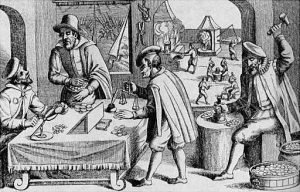
“A German mint hard at work producing debased coinage designed to be palmed off on the nearest neighboring state, c.1620”
Courtesy of the Smithsonian Institution
The blog of the Smithsonian Magazine provides an even more vivid look into this event, “Kipper und Wipper”: Rogue Traders, Rogue Princes, Rogue Bishops and the German Financial Meltdown of 1621-23:
What made the kipper- und wipperzeit so incredible was that it was the product not only of slipshod economic management, but also of deliberate attempts by a large number of German states to systematically defraud their neighbors. This monetary terrorism had its roots in the economic problems of the late 16th century and lasted long enough to merge into the general crisis of the 1620s caused by the outbreak of the Thirty Years’ War, which killed roughly 20 percent of the population of Germany. While it lasted, the madness infected large swaths of German-speaking Europe, from the Swiss Alps to the Baltic coast, and it resulted in some surreal scenes: Bishops took over nunneries and turned them into makeshift mints, the better to pump out debased coinage; princes indulged in the tit-for-tat unleashing of hordes of crooked money-changers, who crossed into neighboring territories equipped with mobile bureaux de change, bags full of dodgy money, and a roving commission to seek out gullible peasants who would swap their good money for bad. By the time it stuttered to a halt, the kipper- und wipperzeit had undermined economies as far apart as Britain and Muscovy, and—just as in 1923—it was possible to tell how badly things were going from the sight of children playing in the streets with piles of worthless currency.
Economists have long studied the problems “‘bad” money can cause an economy. The effects were first described by Sir Thomas Gresham (1518-79), an English merchant of Queen Elizabeth’s reign. Gresham is remembered for stating what has become known as “Gresham’s Law”—that the bad money in an economy drives out the good. Put more formally, the law implies that an overvalued currency (such as one in which the stated content of precious metal is much less than expected) will result either in the hoarding of good money (because spending it runs the risk of receiving bad money in change) or in the melting down and recoining of good money to make a larger amount of debased coinage.
What happened in Germany after bad money started to circulate there in about 1600 might have been designed as a case study in Gresham’s Law. Coins were increasingly stripped of their gold, silver and copper content; as a result, the imperial currency, the kreuzer, lost about 20 percent of its value between 1582 and 1609. After that, things began to go seriously wrong.
The evidence is persuasive that things today, notwithstanding recurring anxiety in the maverick financial press, are a long way from again going so seriously wrong. And yet, in these days of high political angst, it is well to bear in mind the concluding observation by The Smithsonian:
Kindleberger concludes his study (upon which the author of the blog draws) with a quotation from Macaulay’s History of England that may be allowed to stand for the Kipper- und Wipperzeit—and indeed for all hyperinflations. Writing of a similar English wave of coin-clipping that occurred in 1696, the great historian observed:
It may well be doubted whether all the misery which has been inflicted on the English nation in a quarter of a century by bad Kings, bad Ministers, bad Parliaments and bad Judges, was equal to the misery caused in a single year by bad crowns and bad shillings.
Recent Comments