
Originally posted on Thursday, November 7th, 2013
“I met a traveler from an antique land….”
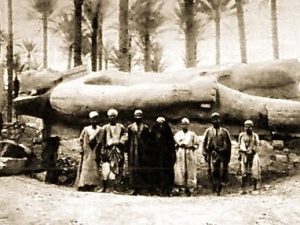
Statue of Ramses II, courtesy of TourEgypt.net
Two prior blogs, here, referenced the demolition, by Niall Ferguson, of any vestiges of credibility that Paul Krugman might still have possessed in polite society. Ferguson spreads many of Krugman’s errors and omissions upon the record … for all to marvel upon.
In this, Ferguson casts Krugman in the role of Shelley’s Ozymandias:
I met a traveller from an antique land
Who said: `Two vast and trunkless legs of stone
Stand in the desert. Near them, on the sand,
Half sunk, a shattered visage lies, whose frown,
And wrinkled lip, and sneer of cold command,
Tell that its sculptor well those passions read
Which yet survive, stamped on these lifeless things,
The hand that mocked them and the heart that fed.
And on the pedestal these words appear —
“My name is Ozymandias, king of kings:
Look on my works, ye Mighty, and despair!”
Nothing beside remains. Round the decay
Of that colossal wreck, boundless and bare
The lone and level sands stretch far away.’
Some selections from Ferguson’s Part 3, the (currently) final episode:
In my previous two articles, I have shown that Paul Krugman – revered by his acolytes as the Invincible Krugtron – failed to anticipate the financial crisis and wrongly predicted that the single European currency would fall victim to it. I have exploded his claim to intellectual invincibility. Very clearly, he has made at least twice as many major mistakes in his career as the mere two he has previously admitted to.
You may ask: Why have I taken the trouble to do this? I have three motives. The first is to illuminate the way the world really works, as opposed to the way Krugman and his beloved New Keynesian macroeconomic models say it works. The second is to assert the importance of humility and civility in public as well as academic discourse. And the third, frankly, is to teach him the meaning of the old Scottish regimental motto: nemo me impune lacessit (“No one attacks me with impunity”).
I am not an economist. I am an economic historian. The economist seeks to simplify the world into mathematical models – in Krugman’s case models erected upon the intellectual foundations laid by John Maynard Keynes. But to the historian, who is trained to study the world “as it actually is”, the economist’s model, with its smooth curves on two axes, looks like an oversimplification. The historian’s world is a complex system, full of non-linear relationships, feedback loops and tipping points. There is more chaos than simple causation. There is more uncertainty than calculable risk.
So we public intellectuals should not brag too loudly when we get things right. Nor should we condemn too harshly the predictions of others that are subsequently falsified by events. The most that we can do in this unpredictable world is read as widely and deeply as we can, think seriously, and then exchange ideas in a humble and respectful manner. Nobody ever seems to have explained this to Paul Krugman. There is a reason that his hero John Maynard Keynes did not go around calling his great rival Friedrich Hayek a “mendacious idiot” or a “dope”.
For too long, Paul Krugman has exploited his authority as an award-winning economist and his power as a New York Times columnist to heap opprobrium on anyone who ventures to disagree with him. Along the way, he has acquired a claque of like-minded bloggers who play a sinister game of tag with him, endorsing his attacks and adding vitriol of their own. I would like to name and shame in this context Dean Baker, Josh Barro, Brad DeLong, Matthew O’Brien, Noah Smith, Matthew Yglesias and Justin Wolfers. Krugman and his acolytes evidently relish the viciousness of their attacks, priding themselves on the crassness of their language. But I should like to know what qualifies a figure like Matt O’Brien to call anyone a “disingenuous idiot”? What exactly are his credentials? 35,550 tweets? How does he essentially differ from the cranks who, before the Internet, had to vent their spleen by writing letters in green ink?
Where I come from, however, we do not fear bullies. We despise them. And we do so because we understand that what motivates their bullying is a deep sense of insecurity. Unfortunately for Krugtron the Invincible, his ultimate nightmare has just become a reality. By applying the methods of the historian – by quoting and contextualizing his own published words – I believe I have now made him what he richly deserves to be: a figure of fun, whose predictions (and proscriptions) no one should ever again take seriously.
Once again, note the emphasis on the value of history over deracinated intellect.
Indeed, history, as getting to the root, is (both literally and figuratively) the more radical approach.
Prof. Ferguson has called out Prof. Krugman and “named and shamed” his acolytes, as blackguards, hooligans, and thugs but one step (if that) removed from cranks, albeit cranks who have been provided — to their editors’ shame — distinguished venues.
A distinguished venue does not give one liberty to behave like a thug.
High praise to Niall Ferguson for playing Joseph Welch to Paul Krugman, who has made himself the economics profession’s Joe McCarthy, for stating as plainly as did the heroic Welch:
“Have you no sense of decency sir, at long last? Have you left no sense of decency?”
Paul Krugman is discredited.
Recent Comments