
Originally posted on Thursday, August 22nd, 2013
Dante, in the Divine Comedy, places counterfeiters at the bottom of the Eighth Circle of Hell to which the souls of those guilty of conscious fraud are consigned.
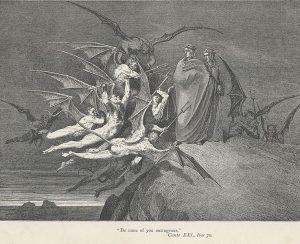
According to the Wikipedia, this is “one of the worst places in hell to be.”
In Dante’s version of hell, categories of sin are punished in different circles, with the depth of the circle (and placement within that circle) symbolic of the amount of punishment to be inflicted. Sinners placed in the upper circles of hell are given relatively minor punishments, while sinners in the depths of hell endure far greater torments. As the eighth of nine circles, Malebolge is one of the worst places in hell to be. In it, sinners guilty of “simple” fraud are punished (that is, fraud that is committed without particularly malicious intent, whereas Malicious or “compound” fraud — fraud that goes against bond of love, blood, honor, or the bond of hospitality — would be punished in the ninth circle). Sinners of this category include counterfeiters, hypocrites, grafters, seducers, sorcerers and simonists.
By Longfellow’s translation of Canto XXX:
For them am I in such a family; They did induce me into coining florins, Which had three carats of impurity.”
And I to him: “Who are the two poor wretches That smoke like unto a wet hand in winter, Lying there close upon thy right-hand confines?”
“I found them here,” replied he, “when I rained Into this chasm, and since they have not turned, Nor do I think they will for evermore.
One the false woman is who accused Joseph, The other the false Sinon, Greek of Troy; From acute fever they send forth such reek.”
And one of them, who felt himself annoyed At being, peradventure, named so darkly, Smote with the fist upon his hardened paunch.
It gave a sound, as if it were a drum; And Master Adam smote him in the face, With arm that did not seem to be less hard,
Saying to him: “Although be taken from me All motion, for my limbs that heavy are, I have an arm unfettered for such need.”
Whereat he answer made: “When thou didst go Unto the fire, thou hadst it not so ready: But hadst it so and more when thou wast coining.”
The dropsical: “Thou sayest true in that; But thou wast not so true a witness there, Where thou wast questioned of the truth at Troy.”
“If I spake false, thou falsifiedst the coin,” Said Sinon; “and for one fault I am here, And thou for more than any other demon.”
“Remember, perjurer, about the horse,” He made reply who had the swollen belly, “And rueful be it thee the whole world knows it.”
“Rueful to thee the thirst be wherewith cracks Thy tongue,” the Greek said, “and the putrid water That hedges so thy paunch before thine eyes.”
Then the false-coiner: “So is gaping wide Thy mouth for speaking evil, as ’tis wont; Because if I have thirst, and humour stuff me
Thou hast the burning and the head that aches, And to lick up the mirror of Narcissus Thou wouldst not want words many to invite thee.”
How much greater the wickedness to falsify a nation’s coinage — and that, even, of the world — than diminishing a few florins with “a few carats of impurity”?
Recent Comments