
Originally posted on Thursday, July 11th, 2013
Lord Keynes, wrote, in 1925, “The Economic Consequences of Mr. Churchill” — a trenchant critique of Churchill’s 1925 resumption of the gold standard at pre-war parities (around 10% above prevailing price levels).
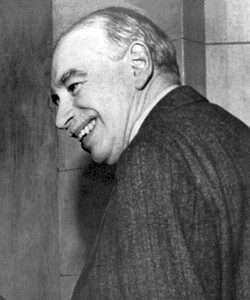 Image courtesy of Wikipedia

He, explicitly, therein, was not critiquing the gold standard itself. In speculating about how Chancellor Churchill could have been so ill advised, he wrote:
“I think that the minds of his advisers still dwelt in the imaginary academic world, peopled by City [ed. Note: the then-equivalent of Wall Street] editors, members of Cunliffe and Currency Committees et hoc genus omne, where the necessary adjustments follow “automatically” from a “sound” policy by the Bank of England. …
Their arguments—if their vague and jejune meditations can be called such—are there for any one to read.
As Lehrman Institute founder and chairman Lewis E. Lehrman repeatedly has observed, the only legitimate grounds for evaluating policy reside in “the laboratory of human history.” The “imaginary academic world” as indicted, quite percipiently, by Keynes, provides neither necessary nor sufficient framework.
Recent Comments