
Originally posted onTuesday, February 26, 2013
“[A]lthough gold and silver are not by nature money, money is by nature gold and silver….” – Karl Marx
Karl Marx, in his A Contribution to the Critique of Political Economy, demonstrates sophisticated grasp of the workings of the classical gold standard.
Much of the Contribution is dedicated to the question of money.
Marx shows a discerning appreciation about the role of the classical gold standard.
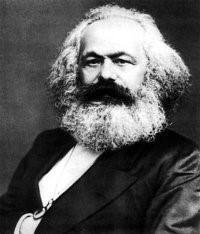 Karl Marx
And as he concludes his preface,
At the entrance to science, as at the entrance to hell, the demand must be made:
Qui si convien lasciare ogni sospetto
Ogni vilta convien che qui sia morta.
[From Dante, Divina Commedia:
Here must all distrust be left;
All cowardice must here be dead.]
Marx’s assessment perhaps is best expressed when he writes, in Chapter 1, Part 1: “The truth of the proposition that, ‘although gold and silver are not by nature money, money is by nature gold and silver,” is shown by the fitness of the physical properties of these metals for the functions of money.”
From Chapter 2, Money or Simple Circulation, Part 1, Measure of Value:
The difference between exchange-value and price is, on the one hand, merely nominal; as Adam Smith says, labour is the real price of commodities and money their nominal price. Instead of saying that one quarter of wheat is worth thirty days’ labour, one now says it is worth one ounce of gold, when one ounce of gold is produced in thirty working days. The difference is on the other hand so far from being simply a nominal difference that all the storms which threaten the commodity in the actual process of circulation centre upon it. A quarter of wheat contains thirty days’ labour, and it therefore does not have to be expressed in terms of labour-time. But gold is a commodity distinct from wheat, and only circulation can show whether the quarter of wheat is actually turned into an ounce of gold as has been anticipated in its price. This depends on whether or not the wheat proves to be a use-value, whether or not the quantity of labour-time contained in it proves to be the quantity of labour-time necessarily required by society for the production of a quarter of wheat. The commodity as such is an exchange-value, the commodity has a price. This difference between exchange-value and price is a reflection of the fact that the particular individual labour contained in the commodity can only through alienation be represented as its opposite, impersonal, abstract, general – and only in this form social – labour, i.e., money. Whether it can be thus represented or not seems a matter of chance. Although, therefore, the price gives exchange-value a form of existence which is only nominally distinct from the commodity, and the two aspects of the labour contained in the commodity appear as yet only as different modes of expression; while, on the other hand, gold, the embodiment of universal labour-time, accordingly confronts concrete commodities merely as an imaginary measure of value; yet the existence of price as an expression of exchange-value, or of gold as a measure of value, entails the necessity for alienation of commodities in exchange for glittering gold and thus the possibility of their non-alienation. In short, there is here contained in latent form the whole contradiction which arises because the product is a commodity, or because the particular labour of an isolated individual can become socially effective only if it is expressed as its direct opposite, i.e., “abstract universal labour. The utopians who wish to retain commodities but not money, production based on private exchange without the essential conditions for this type of production, are therefore quite consistent when they seek to “abolish” money not only in its palpable state but even in the nebulous, chimerical state that it assumes as the measure of value. For beneath the invisible measure of value lurks hard money.
Given the process by which gold has been turned into the measure of value and exchange-value into price, all commodities when expressed in their prices are merely imagined quantities of gold of various magnitudes. Since they are thus various quantities of the same thing, namely gold, they are similar, comparable and commensurable, and thus arises the technical necessity of relating them to a definite quantity of gold as a unit of measure. This unit of measure then develops into a scale of measure by being divided into aliquot parts which are in turn subdivided into aliquot parts. [2] The quantities of gold themselves, however, are measured by weight. The standard weights generally used for metals accordingly provide ready-made standard measures, which originally also served as standard measures of price wherever metallic currency was in use. Since commodities are no longer compared as exchange-values which are measured in terms of labour-time, but as magnitudes of the same denomination measured in terms of gold, gold, the measure of value, becomes the standard of price. The comparison of commodity-prices in terms of different quantities of gold thus becomes crystallised in figures denoting imaginary quantities of gold and representing gold as a standard measure divided into aliquot parts. Gold as measure of value and as standard of price has quite distinct specific functions, and the confusion of the one with the other has led to the most absurd theories. Gold as materialised labour-time is a measure of value, as a piece of metal of definite weight it is the standard of price. Gold becomes the measure of value because as an exchange-value it is compared with the exchange-values of other commodities; in its aspect as a standard of price a definite quantity of gold serves as a unit for other quantities of gold. Gold is the measure of value because its value is variable; it is the standard of price because it has been established as an invariable unit of weight. Here, as in all cases of measuring quantities of the same denomination, stability and exactitude of the proportions is essential. The necessity of establishing a quantity of gold as the unit of measure and its aliquot parts as subdivisions of this unit has given rise to the idea that a fixed ratio of values has been set up between a definite quantity of gold, whose value is of course variable, and the exchange-values of commodities. But such a view simply ignores the fact that the exchange-values of commodities are turned into prices, into quantities of gold, before gold becomes the standard of price. Quite irrespective of any changes in the value of gold, different quantities of gold will always represent the same ratio of values with regard to one another. lf the value of gold should fall by 1,000 per cent, then the value of twelve ounces of gold would still be twelve times bigger than that of one ounce of gold, and so far as prices are concerned what matters is only the proportion of the different quantities of gold to one another. Since, on the other hand, a rise or fall in the value of an ounce of gold does not in any way affect its weight, the weight of its aliquot parts remains likewise unaffected; gold can thus always serve as a stable standard of price, regardless of any changes in its value. [3]
As a result of an historical process, which, as we shall explain later, was determined by the nature of metallic currency, the names of particular weights were retained for constantly changing and diminishing weights of precious metals functioning as the standard of price. Thus the English pound sterling denotes less than one-third of its original weight, the pound Scots before the Union only 1/36, the French livre 1/74, the Spanish maravedi less than 1/1,000 and the Portuguese rei an even smaller proportion. Historical development thus led to a separation of the money names of certain weights of metals from the common names of these weights. [4]Because the designation of the unit of measure, its aliquot parts and their names is, on the one hand, purely conventional, and on the other hand must be accepted as universal and indispensable within the sphere of circulation, it had to be established by legal means. The purely formal enactment thus devolved upon the government. [5] Which particular metal served as the material of money depended on the given social conditions. The standard of price is of course different in different countries. In England, for example, the ounce as a weight of metal is divided into pennyweights, grains and carats troy; but the ounce of gold as the unit of money is divided into 3 7/8 sovereigns, the sovereign into 20 shillings and the shilling into 12 pence, so that 100 pounds of 22-carat gold (1,200 ounces) equal 4,672 sovereigns and 10 shillings. But in the world market, where state frontiers disappear, such national features of the standards of money disappear as well and are replaced by measures of weight generally used for metals.
The price of a commodity, or the quantity of gold into which it is nominally converted, is now expressed therefore in the monetary names of the standard of gold. Thus, instead of saying a quarter of wheat is worth an ounce of gold, one would say in England it is worth £3 17s. 10/2d. All prices are thus expressed in the same denomination. The specific form which the exchange-value of commodities assumes is converted into denominations of money, by which their value is expressed. Money in turn becomes money of account. [6]
The transformation of commodities into money of account in the mind, on paper or in words takes place whenever the aspect of exchange-value becomes fixed in a particular type of wealth. [7] This transformation needs the material of gold, but only in imagination. Not a single atom of real gold is used to estimate the value of a thousand bales of cotton in terms of a certain number of ounces of gold and then to express this number of ounces in £. s. d., the names of account of the ounce. For instance, not a single ounce of gold was in circulation in Scotland before Sir Robert Peel’s Bank Act of 1845, although the ounce of gold, called £3 17s. 10/2d. as the British standard of account, served as the legal standard of price. Similarly, silver serves as the standard of price in exchange of commodities between Siberia and China, although this trade is in fact merely barter. It makes no difference, therefore, to gold as money of account whether or not its standard unit or its subdivisions are actually coined. During the reign of William the Conqueror, one pound sterling, at that time a pound of pure silver, and the shilling,½0 of a pound, existed in England only as money of account, while the penny,½40 of a pound of silver, was the largest silver coin in existence. On the other hand, there are no shillings or pence in England today, although they are legal names of account for definite fractions of an ounce of gold. Money as money of account may exist only nominally, while actually existing money may be coined according to an entirely different standard. Thus in many of the English colonies in North America, the money in circulation consisted of Spanish and Portuguese coins till late in the eighteenth century, whereas the money of account was everywhere the same as in England. [8]
Because as standard of price gold is expressed by the same names of account as the prices of commodities – for example £3 17s. 10½d. may denote an ounce of gold just as well as a ton of iron – these names of account are called the mint-price of gold. Thus the queer notion arose that gold is estimated in its own material and that, unlike all other commodities, its price is fixed by the State. The establishing of names of account for definite weights of gold was mistaken for the establishing of the value of these weights. [9] Gold has neither a fixed price nor any price at all, when it is a factor in the determination of prices and therefore functions as money of account.
Recent Comments