
Originally posted on Thursday, September 13th, 2012
A particularly notorious part of FDR’s efforts to find a way to lift the Depression was an executive order requiring all, with very narrow limitations, under threat of prosecution, to turn in their gold holdings for currency. This occurred shortly prior to the revaluation of the dollar from $20.67/oz to, in stages, $35.
Nobody, in the event, was incarcerated (the sole prosecution failing on a technicality). Yet FDR’s confiscation of gold may be viewed as the monetary policy equivalent of his regrettable policy, also executed by Executive Order, of interning 110,000 Japanese Americans–a stain upon the great man’s reputation.
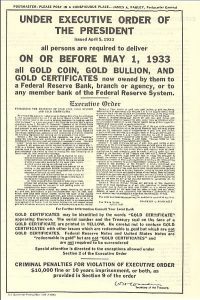 Executive Order 6102
In his first Fireside Chat, FDR observed:
After all, there is an element in the readjustment of our financial system more important than currency, more important than gold, and that is the confidence of the people themselves. Confidence and courage are the essentials of success in carrying out our plan. You people must have faith; you must not be stampeded by rumors or guesses. Let us unite in banishing fear. We have provided the machinery to restore our financial system; and it is up to you to support and make it work.
It is your problem, my friends, your problem no less than it is mine.
Together we cannot fail.
Liaquat Ahamed’s Pulitzer Prize winning Lords of Finance observes of FDR’s varied measures to lift the Depression:
The string of measures was a strange mixture of well-meaning steps at social reform, half-baked schemes for quasi-socialist industrial planning, regulation to protect consumers, welfare programs to help the hardest hit, government support for the cartelization of industry, higher wages for some, lower wages for others, on the one hand government pump priming, on the other public economy. Few elements were well thought out, some were contradictory, large parts were ineffectual.
Revaluing gold to $35/oz to lift the distortions created by the gold-exchange standard was the correct, and essential, approach. Confiscating gold had nothing to do with this, yet both measures remain somewhat conflated in the popular imagination. And the prohibition on owning gold — which persisted into the 1970s — left gold with an aura of something contraband and vaguely sinister, an aura only now beginning to be dispelled.
FDR, the icon of Keynesians, concluded his first Fireside Chat with an exaltation of confidence. It therefore is deeply ironic that polemicist Paul Krugman, who worships at the altar of FDR, should consider one of his signal contributions to the culture the coining of the disparaging phrase “the confidence fairy.” Krugman:
Critics warned from the beginning that austerity in the face of depression would only make that depression worse. But the “austerians” insisted that the reverse would happen. Why? Confidence! “Confidence-inspiring policies will foster and not hamper economic recovery,” declared Jean-Claude Trichet, the former president of the European Central Bank — a claim echoed by Republicans in Congress here. Or as I put it way back when, the idea was that the confidence fairy would come in and reward policy makers for their fiscal virtue.
The good news is that many influential people are finally admitting that the confidence fairy was a myth.
A myth, indeed. And the mythos that anethematizes the gold standard remains a serious barrier to the resumption of vibrant economic growth.
Recent Comments