
Originally posted Tuesday, August 14, 2012
July 31st was the anniversary of the laying of the cornerstone, in 1792, for first U.S. government building: U.S. Mint in Philadelphia (and on the site of an abandoned whiskey distillery). And, by strange coincidence, the birthday, this year the centenary, of Nobel Prize economist Milton Friedman….
Both share a strong association with … money.
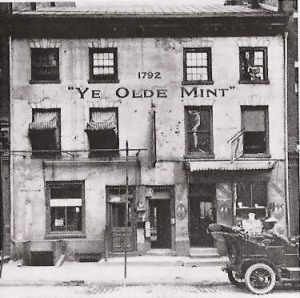 Image courtesy of Wikipedia Commons, Public Domain

According to the numismatic website USCoinValuesAdvisor.com:
On July 31, foundation work for the first (US Mint) building began. By September 7, the building was ready for the installation of the smelting furnace (used to separate ore into its metallic constituents), thus completing the very first public building erected by the United States government.
A few months later, a three-story brick structure fronting Seventh Street was constructed. This was the tallest and most visible of all the first Mint’s buildings, so the words “Ye Olde Mint” were later painted on the building’s facade. (the word “Ye” was Old English spelling for the word “The”, and was pronounced as “The”). Many people erroneously believe the “Ye Olde Mint” building was built first, but according to Don Taxay’s meticulous research in The U.S. Mint and Coinage, the honors go to the smelt house.
In between the “Ye Olde Mint” building and the smelt house, a frame mill house was then built, having a basement where horses turned a rolling mill on the ground level floor above.
The basement [of Ye Olde Mint building] contained vaults that held gold and silver. The first floor was split into deposit and weighing rooms, as well as a press room where gold coins were struck. The second floor was the place where most mint officials had their offices. The third floor held the assay laboratory for testing metals. To travel from floor to floor, one had to walk a dark, creepy stairway, dimly lit by a tallow lamp.
Milton Friedman was born on the anniversary of the commencement of work on the Philadelphia Mint. It is a double irony: Friedman was a towering foe of government; both he and the Mint are closely associated with money. Friedman will be remembered for, among other achievements, co-authoring A Monetary History of the United States, 1867-1960, with Anna J. Schwartz, called by The Economic Journal, “A monumental scholarly accomplishment. . . . [sets] a new standard for the writing of monetary history.”
Friedman spent many years as the premier exponent of monetarism. He quietly distanced himself from that in an a notable June 7, 2003 interview with the Financial Times in which he observed “The use of quantity of money as a target has not been a success. I’m not sure that I would as of today push it as hard as I once did.” Friedman’s observation about Keynes seems applicable: “In every discipline, progress comes from people who make hypotheses, most of which turn out to be wrong, but all of which ultimately point to the right answer. Now Keynes, in The General Theory of Employment, Interest and Money, set forth a hypothesis which was a beautiful one, and it really altered the shape of economics. But it turned out that it was a wrong hypothesis. That doesn’t mean that he wasn’t a great man!” (Quoted in Opinion Journal, 22 July 2006)
Simply because monetarism proved a wrong hypothesis does not mean that Friedman wasn’t a great man. He certainly was. Now, at the centenary of Friedman’s birth, is a fitting time to turn from the endless series of monetary theories propounded by distinguished academics and restore the classical gold standard. Lehrman Institute founder and chairman, and Reagan Gold Commissioner, Lewis E. Lehrman, in testimony before the House Financial Services Subcommittee on Domestic Monetary Policy, called the gold standard — under which the U.S. Mint was created — “the least imperfect monetary system tested in the only laboratory we human beings have available to us: the laboratory of human history.”
Recent Comments