
Originally posted Saturday, May 12, 2012
The gold samples then traveled … by ship to Panama, across the isthmus by horseback, by ship to New Orleans, and overland to Washington.
This is how the Smithsonian Institution describes the famous find at Sutter’s Mill that triggered the great California Gold Rush:
John Marshall was superintending the construction of a sawmill for Col. John Sutter on the morning of January 25, 1848, on the South Fork of the American River at Coloma, California, when he saw something glittering in the water of the mill’s tailrace. According to Sutter’s diary, Marshall stooped down to pick it up and “found that it was a thin scale of what appeared to be pure gold.” Marshall bit the metal as a test for gold.
In June of 1848, Colonel Sutter presented Marshall’s first-find scale of gold to Capt. Joseph L. Folsom, U.S. Army Assistant Quartermaster at Monterey. Folsom had journeyed to Northern California to verify the gold claim for the U.S. Government.
The gold samples then traveled with U.S. Army Lt. Lucien Loeser by ship to Panama, across the isthmus by horseback, by ship to New Orleans, and overland to Washington. A letter of transmittal from Folsom that accompanied the packet lists Specimen #1 as “the first piece of gold ever discovered in this Northern part of Upper California found by J. W. Marshall at the Saw Mill of John A. Sutter.”
By August of 1848, as evidence of the find, this piece and other samples of California gold had arrived in Washington, D.C., for delivery to President James K. Polk and for preservation at the National Institute. Within weeks, President Polk formally declared to Congress that gold had been discovered in California.
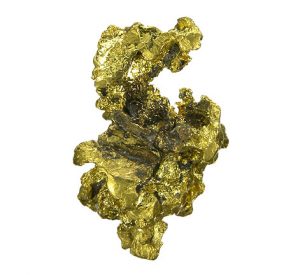 Gold Nugget from the Eureka Mine in Big Oak Flat, California

Many Americans thought the claim of the discovery of gold in California was a fabrication … until President Polk validated it in his 1848 State of the Union message to Congress:
It was known that mines of the precious metals existed to a considerable extent in California at the time of its acquisition. Recent discoveries render it probable that these mines are more extensive and valuable than was anticipated. The accounts of the abundance of gold in that territory are of such an extraordinary character as would scarcely command belief were they not corroborated by the authentic reports of officers in the public service who have visited the mineral district and derived the facts which they detail from personal observation. Reluctant to credit the reports in general circulation as to the quantity of gold, the officer commanding our forces in California visited the mineral district in July last for the purpose of obtaining accurate information on the subject. His report to the War Department of the result of his examination and the facts obtained on the spot is herewith laid before Congress. When he visited the country there were about 4,000 persons engaged in collecting gold. There is every reason to believe that the number of persons so employed has since been augmented. The explorations already made warrant the belief that the supply is very large and that gold is found at various places in an extensive district of country.
“Thus began,” says the California Natural Resources Agency, “one of the largest human migrations in history as a half-million people from around the world descended upon California in search of instant wealth.”
Recent Comments