
Originally posted Thursday, May 10, 2012
When President Gerald R. Ford acceded to the presidency upon the resignation, under pressure, of Richard M. Nixon, on August 9, 1974, inflation rapidly was approaching 12% — double digit territory, rates that America had not seen in over half a century.
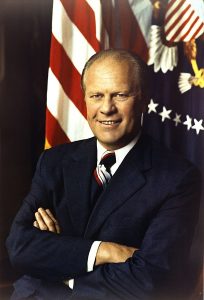 Image courtesy of Wikipedia

On October 8, 1974, President Ford addressed the Congress from these prepared remarks:
During the meetings on inflation, I listened carefully to many valuable suggestions. Since the summit, I have evaluated literally hundreds of ideas, day and night.
My conclusions are very simply stated. There is only one point on which all advisers have agreed: We must whip inflation right now.
None of the remedies proposed, great or small, compulsory or voluntary, stands a chance unless they are combined in a considered package, in a concerted effort, in a grand design.
I have reviewed the past and the present efforts of our Federal Government to help the economy. They are simply not good enough, nor sufficiently broad, nor do they pack the punch that will turn America’s economy on.
A stable American economy cannot be sustained if the world’s economy is in chaos. International cooperation is absolutely essential and vital. But while we seek agreements with other nations, let us put our own economic house in order. Today, I have identified 10 areas for our joint action, the executive and the legislative branches of our Government.
The ten areas turned out to be an ineffectual pastiche of directing farmers to plant more acreage (to raise food supply thus, in naive concept, driving down food prices); reducing oil imports by 1 million barrels a day, increasing domestic supply, promoting clean coal and nuclear power, deregulating natural gas supplies; amending the Clean Air Act; passage of surface mining legislation; regulatory reform; ominous “monitoring” of private sector wage and price increases; making corporate dividends tax deductible; liberalizing the tax treatment of capital gains; providing extra unemployment insurance benefits; provide public works jobs to beautify America; $1.6 billion in tax relief to low and middle-income Americans paid for with a supertax on oil producers; permitting home mortgages to be purchased by federal agencies; restructuring the Savings and Loan industry; trade reform; a 5% tax surcharge; a target spending limit….
My fellow Americans, 10 days ago I asked you to get things started by making a list of 10 ways to fight inflation and save energy, to exchange your list with your neighbors, and to send me a copy.
I have personally read scores of the thousands of letters received at the White House, and incidentally, I have made my economic experts read some of them, too. We all benefited, at least I did, and I thank each and every one of you for this cooperation.
Some of the good ideas from your home to mine have been cranked into the recommendations I have just made to the Congress and the steps I am taking as President to whip inflation right now. There were also firm warnings on what Government must not do, and I appreciated those, too. Your best suggestions for voluntary restraint and self-discipline showed me that a great degree of patriotic determination and unanimity already exists in this great land.
I have asked Congress for urgent specific actions it alone can take. I advised Congress of the initial steps that I am taking as President. Here is what only you can do: Unless every able American pitches in, Congress and I cannot do the job. Winning our fight against inflation and waste involves total mobilization of America’s greatest resources—the brains, the skills, and the willpower of the American people.
Here is what we must do, what each and every one of you can do: To help increase food and lower prices, grow more and waste less; to help save scarce fuel in the energy crisis, drive less, heat less. Every housewife knows almost exactly how much she spent for food last week. If you cannot spare a penny from your food budget—and I know there are many—surely you can cut the food that you waste by 5 percent.
Every American motorist knows exactly how many miles he or she drives to work or to school every day and about how much mileage she or he runs up each year. If we all drive at least 5 percent fewer miles, we can save, almost unbelievably, 250,000 barrels of foreign oil per day. By the end of 1975, most of us can do better than 5 percent by carpooling, taking the bus, riding bikes, or just plain walking. We can save enough gas by self-discipline to meet our 1 million barrels per day goal.
I think there is one final thing that all Americans can do, rich or poor, and that is share with others. We can share burdens as we can share blessings. Sharing is not easy, not easy to measure like mileage and family budgets, but I am sure that 5 percent more is not nearly enough to ask, so I ask you to share everything you can and a little bit more. And it will strengthen our spirits as well as our economy.
The Ford administration solution to inflation?
Carpooling and similar measures, some good, some bad, and some just plain ugly.
A laundry list that did not treat seriously with monetary policy or the actions of the Federal Reserve.
And while inflation trended down, the evidence is that this was a cyclical matter.
Few economists or policy makers would be willing to argue that the Ford administration’s “Whip Inflation Now” pastiche had anything whatsoever to do with the ensuing lull in inflation.
Who sows the wind will reap the whirlwind.
Gerald R. Ford was not elected to a second term as president of the United States.
Much economic suffering was to follow.
Recent Comments