
Originally posted on Saturday, April 21st, 2012
The gold standard gave America a solid monetary foundation.
That foundation helped see America through the many upheavals of the 19th century. It positioned America to prosper.
Gold was so iconic that a ceremonial railroad spike was used in the conjoining of the seacoasts by the transcontinental railroad, pursuant to law signed by President Lincoln just 7 years earlier.
The railroad reached conclusion on May 10, 1869, and, in its grandeur, was in certain ways equivalent to the Apollo 11 moon landing. The first moon landing took place 100 years, almost precisely, later.
 Duplicate Golden Spike, California Railroad Museum. Image Courtesy of Wikipedia

Per the Wikipedia: On May 10, in anticipation of the ceremony, Union Pacific No. 119 and Central Pacific No. 60 (better known as the Jupiter) locomotives were drawn up face-to-face on Promontory Summit.
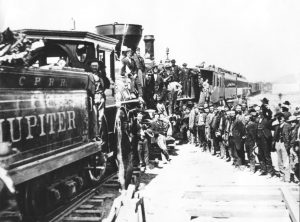 From the National Archives

Yet dismissing the gold standard as a period artifact, as its adversaries do, would be an exercise in hubris rather than wisdom.
Is there anyone who does not long for progress? Perhaps some day someone will invent an improvement on the gold standard. So far, however, the data show that purest form of the gold standard correlates tightly with America’s greatest prosperity. The purported improvement of a fiduciary currency managed by elite civil servants correlate with, over its 40 year course, relative economic stagnation and social impoverishment.
As economic historian and thegoldstandardnow.org advisor Prof. Brian Domitrovic observed in Forbes.com:
… the record of 1878-82 and its own run of some 40% growth. In the four years prior, there had not been a historic collapse in economic growth that made the base year of 1878 low, as was the case in 1933. Rather, in the four years before 1878, growth had come in at 13%; in the previous ten years, growth had totaled 49%. In other words, 1878-82 was a mega-acceleration from a high base.
And after? Over the next decade, another historic expansion of 49%. 49% on top of 40% on top of 49%, 1868 to 1892. That’s registering “the strongest output growth…in US history outside of wartime.”
Regarding policy, there was one major shift that occurred in these heroic years in the latter 19th century. In 1879, the U.S. went back on the gold standard.
That’s right: this epic run of growth, which in no way was inferior to the best that the New Deal and Keynesianism could offer (but that in only a very short span of time), occurred as the dollar regained unimpeachable soundness.“
Recent Comments