
Originally posted Saturday, September 08, 2012
“For currency printers, like undertakers and journalists, upheaval and tumult are good for business.” — The New York Times
Hardly any thought is given to the business of printing currency … a business that proved very lucrative for founding father, and commercial printer, Ben Franklin.
It’s quite a fascinating line of business. The New York Times gave it a grand overview in a piece entitled All About/Currency Printers; the Companies that Make Money From Making Money, in 1992.
Whether they are creating a new monetary unit, redesigning notes that now bear the “wrong” portrait or just replacing bills after their 15 months or so of life, all but about 30 countries in the world rely on a small, interlocked world of “security printers.”
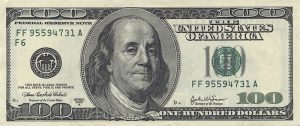 Image courtesy of Wikipedia

The unit of sale is a thousand bills … and currency usually costs $26 to $45 per thousand to make, depending on what optional features a government orders, either to foil counterfeiters or for other reasons. (Some of Israel’s shekels printed by Johan Enschede, for example, have special bumps for blind people to read.)
How much a country orders depends on its population and, more important, its inflation rate, said Mr. Kreitman, “though an order is rarely for less than 50 million notes.”
For currency printers, like undertakers and journalists, upheaval and tumult are good for business.
The Economist recently gave an updated glimpse at the industry in Cash Machine:
FEW businesses do well in a climate of global political instability and mistrust of banks. De La Rue, the world’s largest commercial banknote printer, is one of them. The Basingstoke-based firm’s profits rose by a fifth in 2003 thanks in part to a contract to supply a new currency to Iraq. It also created a currency for the world’s newest country, South Sudan, in time for its independence a year ago. Disintegration of the euro zone would be terrible for most businesses but an opportunity for De La Rue.
Indeed, the financial crisis has broadly been good for banknote printers. The collapse of Lehman Brothers in 2008 led to a surge in demand for the folding stuff, which has not ebbed. Low interest rates have cut the opportunity cost of holding cash. With banks looking wobbly, many prefer to keep their money stuffed in the mattress, creating extra demand for banknotes. After falling steadily during the 1970s and 1980s, as the use of chequebooks and credit cards spread, cash in circulation has been rising again (see chart).
Private-sector printers like De La Rue inhabit a small but vital corner of a huge business. State-owned print works make around 85% of the 150 billion banknotes produced each year. But commercial outfits can be asked to step in when central banks fret that state printers may not be able to meet demand, as De La Rue did for the European Central Bank in 2001. Small countries are more likely to contract out banknote supply to commercial printers, who can harness economies of scale. That logic prompted the Bank of England to outsource its printing to De La Rue in 2003.
The firm devises 100 or so new banknotes each year as well as around 2,000 “design concepts”—a security feature, say, or a new image for a big-denomination bill. It has helped produce more than 150 currencies and won design awards for the banknotes it crafted for the central banks of Kazakhstan and Uganda, among others. De La Rue also prints identity documents, including British passports.
Old money
Trust creates a high entry barrier into the industry. “Few firms can do what we do and those that can have a long history and established relationships with central-bank clients,” says Tim Cobbold, De La Rue’s chief executive. The business was founded in 1813. Portals, a firm it acquired in 1995, has an even longer heritage: it began supplying banknote paper to the Bank of England in 1724. De La Rue’s two main rivals, Munich-based Giesecke & Devrient (G&D), and Oberthur Fiduciaire, a French firm, date back to the mid-19th century.
The true gold standard — the classical gold standard — represents the consensus among the most policy-influential advocates for restoration. And it, unlike the more academic advocates of the gold coin standard, by no means implies a retirement of currency or a threat to the business lines of De La Rue, G&D or Oberthur Fiduciaire. Under the classical gold standard, money (such as the dollar) simply is defined as a fixed weight of gold. Currency legally will be, as it used to be, convertible thereto. Just as “trust creates a high entry barrier into the industry” of currency printers restoring the dollar to trustworthiness by defining it as a fixed weight of gold will prove strong barrier to a return to a fiduciary paper currency system. 41 years of experimentation has demonstrated beyond quibble that the gold standard regulates monetary policy — and promotes economic growth — far more effectively than can 12 sophisticated and well-meaning senior civil servants who make up the membership of the Federal Open Market Committee.
Recent Comments