
Originally posted on Thursday, June 6th, 2013
Discovery.com’s Ian O’Neill reflected about a year ago, on how:
Now that Google’s top brass, a rich Hollywood director, an astronaut and space entrepreneur are on board, it must mean that asteroid mining is just around the corner!
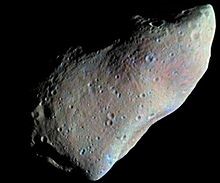 Gaspara, courtesy of Wikipedia

Ahead of today’s much-hyped announcement, Peter Diamandis, a long-time space entrepreneur, space tourist and founder of the X PRIZE, pointed out that a fairly small asteroid — 30 meters wide, say — could contain platinum worth $25 billion to $50 billion.
“Many of the scarce metals and minerals on Earth are in near-infinite quantities in space. As access to these materials increases, not only will the cost of everything from microelectronics to energy storage be reduced, but new applications for these abundant elements will result in important and novel applications,” he said in the Planetary Resources press release.
Forget the California Gold Rush of the 19th century, there’s an unlimited supply of gold in the solar system. What’s more, asteroids have very weak gravitational fields, so we could send spaceships to build a refineries on these interplanetary interlopers and send back chunks of refined minerals very cheaply….
Some debaters like to pull rhetorical gold-rich asteroids out of their top hats as a way of caviling against the gold standard.
They can rest easy (and retire this argument):
The biggest hurdle facing any hopeful space mining company is that we don’t have the ability to refine precious metals and rare minerals in a microgravity environment. Every asteroid mining plan in the past has come with a huge caveat: we don’t have the technology. This may not seem like a huge hurdle — especially considering the amazing feats of human ingenuity in space technology over the past six decades — for investors who actually want to see a return on their investment, it’s probably a deal breaker.
Perhaps it’s not desirable to refine asteroids in situ — might it make sense to capture asteroids in Earth orbit and use them as a near-Earth smorgasbord of resources, cutting off chunks as needed? In this case, I’m highly skeptical that there would be any international agreement about steering potential city-killer asteroids near Earth. That’s one Planetary Health and Safety meeting I’d love to sit in on.
Also, Planetary Resources specifically single out near-Earth asteroids (NEAs) as their target. “Of the approximately 9,000 known NEAs, there are more than 1,500 that are energetically as easy to reach as the Moon,” says the press release. This may be true, but NEAs don’t hang around. They orbit the sun just like the Earth. So is the plan to jump on board, set up a mining platform and then watch billions of dollars of equipment zoom off into deep space until it comes back a year (or ten, or a hundred years) in the future? Or are we going to slow the small NEAs sufficiently so they can be parked in Earth orbit? Once again, messing with an asteroid’s trajectory is a huge technological unknown.
During the announcement, Diamandis kept referring to “risk tolerant investors” investing their “smart money” in the biggest opportunity ever. He also emphasized that Planetary Resources’ goals would enrich humanity as a whole and that their goals were in alignment with NASA’s aims to push humanity into space. Bold words for sure, but, again, there are problems with this vision.
Gold has held a reasonably stable stock to flow ratio for millennia. Asteroid mining possesses a high concept coolness factor for billionaires with time on their hands. But there are no signs that extraterrestrial gold is going to flood Earth’s gold stocks for the foreseeable future. “Risk tolerant investors” indeed.
Recent Comments