
Originally posted on Thursday, March 28th, 2013
The Amber Chamber in the Catherine Palace near Saint Petersburg is decorated with amber panels backed with gold leaf and mirrors. Lovingly crafted in Prussia in the very early 18th century, Prussian king Friedrich Wilhelm I made a gift to it to Czar Peter the Great of the Russian Empire, who expanded it to 55 square meters. It was looted by the Nazis and is presumed lost in the carnage of the Great Patriotic War. It was reconstructed, with donations from Germany, by Russian craftsmen working from 1979 to 2003.
And it is easy to see why the Amber Chamber was sometimes dubbed the “Eight Wonder of the World.”
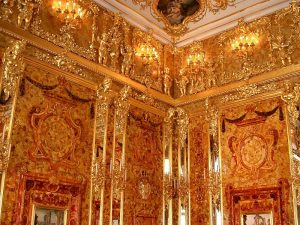 The reconstructed Amber Chamber, photo courtesy of Wikipedia

The Smithsonian Magazine describes it this way:
Golden Gift
Construction of the Amber Room began in 1701. It was originally installed at Charlottenburg Palace, home of Friedrich I, the first King of Prussia. Truly an international collaboration, the room was designed by German baroque sculptor Andreas Schlüter and constructed by the Danish amber craftsman Gottfried Wolfram. Peter the Great admired the room on a visit, and in 1716 the King of Prussia—then Frederick William I—presented it to the Peter as a gift, cementing a Prussian-Russian alliance against Sweden.
The Amber Room was shipped to Russia in 18 large boxes and installed in the Winter House in St. Petersburg as a part of a European art collection. In 1755, Czarina Elizabeth ordered the room to be moved to the Catherine Palace in Pushkin, named Tsarskoye Selo, or “Czar’s Village.” Italian designer Bartolomeo Francesco Rastrelli redesigned the room to fit into its new, larger space using additional amber shipped from Berlin.
After other 18th-century renovations, the room covered about 180 square feet and glowed with six tons of amber and other semi-precious stones. The amber panels were backed with gold leaf, and historians estimate that, at the time, the room was worth $142 million in today’s dollars. Over time, the Amber Room was used as a private meditation chamber for Czarina Elizabeth, a gathering room for Catherine the Great and a trophy space for amber connoisseur Alexander II.
Gold, as money, of course has a purely utilitarian value. It, repeatedly, has been demonstrated to perform better than the discretionary activism of elite civil servants in producing an economic climate most conducive to the generation of equitable prosperity, security, and even liberty.
The quality of aesthetic beauty gold possesses imparts an added value. That value is not at all detrimental to buttressing monetary policy with popular respect.
Gold by no means is a barbarous relic.The aura of the golden … here amber embellished with gold leaf … connotes an apex of civilization: the “eighth wonder of the world.”
The world could do much worse than rebuilding the foundations of the world monetary and financial system upon a foundation of gold.
Indeed, the facts from the laboratory of human history demonstrate that it is highly unlikely the world can do better.
Recent Comments