
Originally posted on Thursday, March 14, 2013
A picturesque byway of human history involves the long, intricate, and convoluted efforts by savants to turn base metals into gold. These savants were called alchemists. Alchemy bears a similar relationship to chemistry as astrology to astronomy.
There is, however, a major distinction between alchemy and astrology. While astrology has been consigned to the fringes of elite discourse the quest to turn base materials into valuable ones — no longer lead into gold, of course, but paper into money — continues apace.
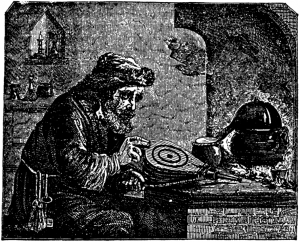 Alchemist from Extraordinary Popular Delusions

The popular history of alchemy was vividly encapsulated in the 1841 classic Extraordinary Popular Delusions and the Madness of Crowds.by Charles Mackay, LL.D. Of this classic work, Wikipedia states that “Michael Lewis includes the financial mania chapters in his book The Real Price of Everything: Rediscovering the Six Classics of Economics as one of the six great works of economics, along with writings by Adam Smith, Thomas Malthus, David Ricardo, Thorstein Veblen, and John Maynard Keynes,” and “Financier Bernard Baruch credited the lessons he learned from Extraordinary Popular Delusions and the Madness of Crowds with his decision to sell all his stock ahead of the financial crash of 1929.”
After three chapters recounting the Mississippi Scheme, the South-Sea Bubble, and The Tulipomania — three iconic (and disastrous) instances of monetary mania — Mackay aptly goes on to provide an extensive review of these follies.
Three causes especially have excited the discontent of mankind; and, by impelling us to seek for remedies for the irremediable, have bewildered us in a maze of madness and error. These are death, toil, and ignorance of the future–the doom of man upon this sphere, and for which he shews his antipathy by his love of life, his longing for abundance, and his craving curiosity to pierce the secrets of the days to come. The first has led many to imagine that they might find means to avoid death, or failing in this, that they might, nevertheless, so prolong existence as to reckon it by centuries instead of units. From this sprang the search, so long continued and still pursued, for the _elixir vitæ_, or _water of life_,which has led thousands to pretend to it and millions to believe in it.From the second sprang the search for the philosopher’s stone, which wasto create plenty by changing all metals into gold; and from the third, the false sciences of astrology, divination, and their divisions of necromancy, chiromancy, augury, with all their train of signs, portents,and omens.
In tracing the career of the erring philosophers, or the wilful cheats,who have encouraged or preyed upon the credulity of mankind, it will simplify and elucidate the subject, if we divide it into three classes:the first comprising alchymists, or those in general who have devoted themselves to the discovering of the philosopher’s stone and the water of life….
What to make of our modern savants, called economists? “Erring philosophers” or “wilful cheats”? Economist Alex Kaiser, in his excellent book, Intervention and Misery: 1929 – 2008, refers to contemporary economists and economics as “witch doctors and … astrology….” Conventional economists appear at least somewhat vulnerable to the charge that they have, to their profit, encouraged or preyed upon “the credulity of mankind.”
Publication by the Bank of England, slightly over a year ago, of Financial Stability Report Number 13 should give those savants pause. The Bank has determined that the Federal Reserve Note standard has, empirically speaking, proved, in practice, greatly inferior in all categories both to the classical gold standard and its Bretton Woods variant. The effort to turn base substances, such as paper (or computer entries), into valuable ones (such as gold) remains as extraordinary a delusion as it was in the Middle Ages.
Recent Comments